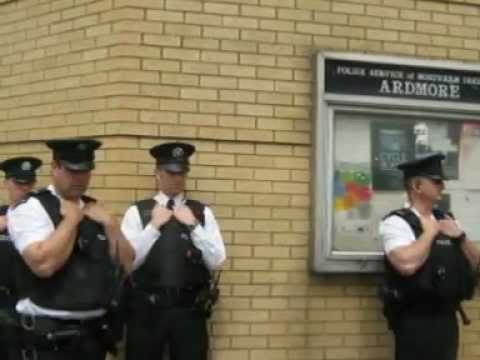
The socialist republican party, éirígí, has said that there would be absolutely no merit or value in taking up an offer to engage with the PSNI in the Newry area.
The offer was put forward by the force after éirígí’s Newry spokesperson, Stephen Murney, condemned the PSNI for taking part in a series of aggressive early morning house raids carried out in the town recently.
The PSNI Area Commander, Davy Beck, had offered to meet with éirígí to discuss the issue.
In response, éirígí's Newry representative Stephen Murney said “There would be absolutely no merit or value in meeting with the PSNI to discuss these matters. This force is responsible for ongoing and repeated human rights’ violations in Newry and elsewhere in the Six Counties.
“Indeed, an independent human rights organisation has published reports which demonstrate that PSNI operations, such as the recent raids in Newry and the use of stop and search powers, are carried out on the instructions of MI5 and are politically motivated.
“It is noticeable that PSNI has never denied the claims made in those reports which also indicate that one third of PSNI personnel could be under the direct control of MI5.
“Even in my own case, the PSNI actions, which included raids on my home and my detention in prison, were shown to be without any basis when the courts dismissed all charges against me. I have yet to hear any acknowledgment or admission from the PSNI that their actions were wrong.
“Our party will not provide credence, or provide any fig-leaf of cover, to the PSNI. Neither will we desist from exposing that force’s ongoing actions that repeatedly result in human rights violations.”
éirígí in Newry have strongly condemned the PSNI for carrying out early morning raids in the Derrybeg area on Wednesday morning and have described the raid as an attack on the entire community.
Heavily armed members of the PSNI's Tactical Support Group (TSG) arrived in force and proceeded to search a house in the estate using "Anti-terror" legislation.
Speaking from Derrybeg éirígí's Newry spokesperson Stephen Murney blasted the PSNI's actions "I witnessed this heavy handed raid this morning and I spoke with the family targeted. This family have lived in this estate for over 50 years and are highly respected in the area. This isn't the first time that this family have been targeted by the state forces in this manner, they have endured numerous house raids over the years. The victim is a former community activist who hasn't been politically active for a number of years due to ill health"
"During the raid numerous boiler suited PSNI members, some of whom were masked, stormed their way into the property along with sniffer dogs. While other PSNI personnel were situated around the house and surrounding streets wielding automatic assault rifles. Damage was also caused to the house during the raid and unsurprisingly nothing was found."
Stephen continued "This isn't just an attack on this family, it is an attack on the entire Derrybeg community. Serious questions also have to be asked of the newly elected councillors, the same people who claim to represent the people in this community. Will they remain forever silent? or will they speak out and condemn such attacks on our community at the hands of the British state forces.
"In recent times elected representatives in Newry & Mourne Council have expressed concern about the treatment of people from other areas at the hands of the PSNI. We demand that they express the same concern and condemnation of similar treatment directed towards their own constituents rather than engage in selective condemnation when it suits them".
"The family in question have thanked éirígí for offering and showing support and solidarity during this ordeal.
Murney concluded "As always éirígí will stand with the victims and will continue to speak out against such human rights abuses. Others should do likewise rather than provide political cover for the perpetrators."
The Anti-Internment Group of Ireland will be holding a white line picket on Saturday 28th June at 3pm in Monaghan St, Newry. Posters and banners will be provided by the organisers.
This event is supported by the IRPWA and they are calling on all members and supporters to attend. The main speaker at the event will be Stephen Murney
In recent times the national media along with the international media have been dominated with headlines in relation to political policing. Indeed some prominent apologists for the British state forces have referred to a "dark side" of policing. Political policing and the "dark side" that comes with it did not just become a reality last Wednesday. It is something that has been part and parcel of British occupation for decades and it's an issue that we in éirígí have been highlighting, exposing and opposing since our party were formed. Yet these new found opponents of political policing demonised and labelled those of us who spoke out against the unchanged nature of British policing, this can only be described as hypocrisy at it's best. Along with the political dark side of policing comes the issue of Internment by remand. Bear in mind, normally, when republicans are arrested Nationalist parties such as Sinn Fein and the SDLP call for them to face "due process", which as we know can include being charged and interned for 14 months and even longer. It's noticable that there were no such calls for "due process" last week from those same quarters. Internment by remand is an issue, which on a regular basis, directly emanates from political policing, and which the PSNI along with the British "justice" system and PPS are directly involved in. It entails the victim going through a conveyor belt type of process which includes several days of interrorgation in Antrim, charged and remanded by a non-jury Diplock court for up to 3 years in Maghaberry before the case either collapses or the charges are withdrawn. I would urge all right minded people to oppose and speak out against political policing and Internment, not only when it suits or directly effects them but each time it happens. To remain silent is to accept it and to engage in selective condemnation means simply to ignore the reality of British policing in Ireland. To quote Patsy O Hara "After we are gone what will you say you were doing? Will you say you were with us in our struggle? Or were you conforming to the very system that drove us to our deaths?" Is mise Stephen Murney éirígí Newry
éirígí in Newry have raised concerns after a Derrybeg resident came across a syringe close to a children’s play park.
The syringe was found in Second Avenue, where many young people play daily.
Commenting on the incident éirígí's Newry spokesperson Stephen Murney said “A local resident contacted our party after they came across a syringe lying in the street. The resident then safely disposed of the syringe”
“While it’s unclear if the syringe was for legitimate medical use or if it was of a more sinister background, the very fact that it was left lying in a residential street, a few yards from a children’s play park is very concerning”
Stephen continued “If a young child had of come across this syringe, the outcome could have been very serious. I would urge any young people who may come across anything of this nature not to touch it but to contact a responsible adult, to ensure that it is disposed of responsibly”
The PSNI targeted those attending the National Graves Association event at Easter.
Sarah Murphy speaking at the NGA event
Among those stopped and searched by the PSNI prior of the commemorative event was 80 year old Sarah Murphy. Sarah is the National Graves Association representative for the area and is a well respected local veteran Republican.
Sarah was spread eagled at the side of the road and was vigorously searched, along with several other people, by heavily armed members of the PSNI militia, who claimed they were searching for ammunition, wireless apparatus and transmitters.
éirígí's Newry representative Stephen Murney who attended the event and witnessed the harassment explained "It's not surprising that the PSNI sought to target those who simply wished to remember Ireland's patriot dead in a dignified fashion.
"It matters not the age or gender of the individual, as this incident proves. This is simply political policing of Irish Republicans. I have no doubt in my mind that Sarah Murphy will be totally unfazed by this"
It is a privilege to join with you today to pay tribute to all those who died for Irish freedom, not only during the Easter rising of 1916 but in every period of our long struggle.
Easter is a time when Republicans gather at gravesides and monuments across Ireland to remember those who have died in pursuit of Irish Freedom.
It is also a time when we recommit ourselves to the pursuance of Republican objectives; objectives which were clearly enunciated in the Proclamation of 1916.
This year and, indeed, this month marks the centenary of the formation of CumannnamBan.
Most of you are wearing an Easter Lily – an emblem first designed in 1925 by CumannnamBan to remember Ireland’s patriot dead.
It is only fitting that, this year, as we remember all our Republican dead, we pay a special tribute to all those women who played a full and active part in our liberation struggle.
Ireland has a long and noble record of many women who played, and who continue to play, prominent and leading roles in the struggles for national freedom, for social justice and for economic equality for all.
Women in Ireland took up arms, raised funds, and hid fugitives during the Rebellion of 1798.
In Wexford, Antrim and Down, women marched into combat beside the men and died beside them on the same battlefields.
Betsy Gray, Mary Ann McCracken, Anne Devlin, were but a few of the many courageous women of that era.
Thegreat strikes of 1913 that led up to the Dublin Lock-Out included many women workerswho, later that year, founded the Irish Womens’ Worker’s Union.
The Irish Citizen Army,first formed as a workers’ defence force during the Lock-Out, included women in its ranks and accorded them equal status with the men.
The founding of CumannnamBan in 1914 was an important step forward by women in assertingtheirown role in Irish politics and assistingin the wider radicalisation of Irish women.
In 1914, Mary Spring Rice and Molly Childers served notice of the latent power that women could bring to the growing revolutionary movement when they were part of the crew on board the Asgard which landed arms for the Volunteers in Howth.
The Proclamation of the Provisional Government read aloud by PadraicPearse outside the GPO in 1916 was addressed to Irishmen and Irishwomen alike.
That declaration of freedom gave women equal citizenship, equal opportunities and equal rights in the new Irish Republic.
Ireland’s women, through the Irish Citizen Army and CumannnamBan, were directly involved during the fighting of Easter week.
Countess Marckievicz was in charge of Republican forces at Stephen’s Green. Among the last people to leave the GPO in 1916 were CumannnamBan members Julia Grenan, Elizabeth O’Farrell and Belfast’s Winifred Carney who is buried in this cemetery.
Along with over seventy other women, theyeach imprisoned by the British for their part in the Rising.
Women’s involvement in the Republican struggle intensified during the Tan War and the period of the counter revolution.
Hundreds of women were imprisoned during that time.
The membership of CumannnamBanunanimously rejectedthe Treaty of 1921. All six female TDs of the Dail, including Mary MacSwiney, Margaret Pearse and Kathleen Clarke, voted against the Treaty and partition.
They knew only too well that their quest for freedom, rights and equality would be undermined by partition and by the Free State’s subjection to the British Crown.
In the following decades, during the 30’s, 40’s, 50’s, through to more recent times, CumannnamBan continued to be at the forefront of the struggle for Irish freedom.
All those women made great sacrifices—they gave up their previously peaceful existences for the Republican struggle.
Many of those women lost husbandsand sons, lost boyfriends, postponed marriages and other life plans, spent time in prison, on hunger-strikes, and they experiencedreprisals against their families by the state.
Some, like the late MaireDrumm and Patricia Black, along with others brave women, ultimately gavetheir own lives.
In this centenary year of the formation of CumannnamBan, it is right that we salute and honour all those women who, across many generations, have played a part in our national liberation struggle.
In that respect, it is correct that we acknowledge and send solidarity to those women who are currently imprisoned in Ireland for their political beliefs – women such as Ursula NíShionnain in Limerick gaol and Sharon Rafferty, Christine Connors and NualaGormley in Hydebank.
We also send solidarity to our Palestinian sisters in struggle imprisoned by the Israeli state.
When Mairéad Farrell stated that Irishwomen had been oppressed both as women and as Irish people, she spoke an undeniable truth.
It is always worth reminding ourselves that women’s participation in the Republican struggle was never just about achieving national liberation, it has also been about the struggle of working-class women for better living conditions, for better working conditions and pay, for a radical political voice and for an end to discrimination and injustice in all its forms.
For our own part, as Irish Republicans and as socialists, we should always strive to fully ensure within our own activities and engagements that our female comrades are treated equally and respectfully, that their opinions are listened to and that their presence, advice and knowledge is valued and appreciated.
We gather here to remember all those died in the struggle for national freedom.
The struggle taken up by Republicans in 1916 was carried on by many other courageous men and women.
All those whom we honour today saw the injustice caused by the British occupation of their country and by the unjust exploitation of this country’s resources by a small minority and they decided to act.
Today, almost a century after the 1916 Rising, Ireland remains controlled by imperialism, albeit in new and more subtle forms.
The livelihoods of the vast majority of Irish people are controlled by unjust and undemocratic forces which stretch from this island to London, to Washington and Brussels.
They are no different to the same undemocratic controlling forces which Connolly, Clarke, Pearse and many other fallen comrades mobilised against during their life-times.
A chairde, the business of establishing the free, sovereign and independent Irish Republic declared in 1916 remains unfinished.
The goals and objectives of those who fought, who were imprisoned, and who were executed, are far from complete.
Those whom we honour today did not engage in struggle to defend or maintain British rule.
They did not engage in struggle to defend or legitimise partition.
Those whom we honour today sought an end to imperialism and monarchy.
They did not seek to dine with, or pay deference to, any figure-head representing those unjust political, social and economic systems.
Over the next two years as the centenary year of the Easter Rising draws near, the modern-day forces of counter-revolution will embark upon an unprecedented revisionist propaganda campaign aimed at trying to persuade the public mind that the objectives of 1916 have been secured through the partition of our country.
We must be prepared to challenge that propaganda campaign both north and south.
We must educate others into the nature of the Irish Republican struggle; our struggle is about achieving real political freedom; it is about delivering social justice; it is about economic equality for all.
The task for all of us is to create a new vision of a new Irish Republic and to re-ignite the inherent desire for true political, social and economic freedom and justice that exists among all people on this island.
As we remember our patriot dead with pride, let their example encourage us all to continue with the struggle to achieve a free, and truly independent, 32 county Irish Republic.
And as we honourall our Republican patriot dead, let us also pause and reflect on all those women of all nations who, in this 21st century, are engaged in struggle around the world – from Ireland to Palestine, Africa and South America.
They still continue with their opposition toforeign aggression, occupation, displacement and deprivation of the most basic human, economic, social and political rights.
James Connolly paid his own tribute to all such women in struggle when he wrote one year before his own execution at the hands of British forces:
“There are none so fitted to break the chains as they who wear them, none so well equipped to decide what isa fetter. In its march towards freedom, the working class of Ireland must cheer on the efforts of those women who, feeling on their souls and bodies the fetters of the ages, have arisen to strike them off.”